Monday, June 27, 2011

Kyrgyzstan I, Osh I

On Kyrgyz side the border are the suburbs of the second largest city Kyrgyzstan, Osh. The transfer from the border to the next town was therefore not a rip off, a welcome change. The hostel where I wanted to spend the night was unfortunately full, already. This gave me another night in a Soviet-style hotel.
In the thirteen days I'll spend in Kyrgyzstan, I won’t get closer to my destination Singapore. I'll make a loop from Osh to the north and then come back to Osh via the west of Kyrgyzstan. Then I will leave of Osh by bus to China.
In Osh, there is not much to see, besides the huge bazaar and the climate is the same as in Uzbekistan (hot). That's why I wanted to spend only a day there. Therefore I had to do a number of organizational matters on that day: getting money and exchange it, buy a sim card and bus ticket to China, and organize a place to stay in Bishkek. At the end of the day I had done all this.
The next day was dominated by the 11-hour taxi ride from Osh to Bishkek. To my luck Nora and Max from Berlin took the same taxi, so I could at least chat a bit. The route goes through the agriculturally shaped Ferghana Valley for the first two hours and is then getting more spectacular. We went past a dam, crossed 3000 + meter high mountain passes and high plains, which are fringed with traditional yurts (tents made of boiled wool) of shepherds.

Uzbekistan IV, Andijan

Andijan is located in the Fergana Valley. The Fergana Valley is a fertile, green place. Cotton and wheat are the major income sources for the locals.
I went there to cross the nearby Kyrgyz border. Before I did this I spent one and a half days there. During this time, my highlight was, that I managed to eat the Uzbek national dish plov. It was excellent.
On Friday morning I made my way to the border. My information was that the border was closed eventually. Since my Uzbek visa expired that day I had two alternatives for this case. I could either extend my visa or I could take a taxi to Tashkent and from there a flight to the Kyrgyz capital Bishkek. To my relief, I could cross the border without any problems.

Sunday, June 26, 2011

Asian leg of the journey II - Central Asia

Finally I created this map. It shows the Central Asian leg of my journey from Germany to Singapore. From Turkmenistan to China. Now im in Bishkek, Kyrgyzstan.


View Asien II - Zentral Asien in a larger map

Thursday, June 23, 2011

Uzbekistan III, Tashkent

We arrived two hours late at 10 pm in Tashkent .From the train station we took a cab to a hotel, which was in the guidebook. However, the hotel could not accommodate us, because it had no license for foreigners. This was the start of an odyssey through Tashkent. Hotels were full, had no license for foreigners or were simply too expensive. By 1 am I was in my hotel room.
The next morning my alarm clock rang at 7:30. I had to get my Chinese visa. I asked the receptionist to mark the location of the hotel on my map and took a taxi to the Chinese embassy. At the embassy, I was largely ignored for two hours. Then they gave me a six-page, English form. Five minutes before the end of business hours I could drop off my form, passport and a few dollars. In the afternoon I picked up my visa. During the waiting time at the embassy, I chatted with a nice young Uzbek girl. Kamola offered to show me a bit of Tashkent on the following evening.
In the afternoon I tried to return back to my hotel. Unfortunately, this was somewhat complicated, because the lady at the reception marked the wrong spot on my map. After 45 minutes of walking around, I decided that before I spend a long time in an errant taxi through the city, google maps could be more useful. My hotel was a twenty minute walk from the Internet cafe.
The next day I visited the huge Chorsu bazaar and the Uzbek History Museum. The museum is very well until the beginning of communism, then it portraits the Uzbeks as resistance fighters against communist oppression. In the most recent part of the museum there is a glorification of the achievements of the President.
In the evening I met with Kamola. She showed me a few places in Tashkent. My personal favorite is the subway station Kosmonatvlar. This place was dedicated to the Soviet cosmonauts. It is decorated in blue toners and reminiscent of a 60’s science fiction film. On the walls portraits of cosmonauts (including Yuri Gargarin) are painted. Unfortunately, photography in the subway is prohibited.
With the Chinese visa in my passport, I could move further in the direction of the Kyrgyz border. But before I did that I said goodbye to Remi and Francois, who would fly to India in the next few days.


Uzbekistan II, Samarkand

The bus trip from Burkhara to Samarkand was the most exhausting mode of transportation on my trip, so far. The bus was at least 25 years old and had been parked in the sun for a couple of hours. Five hours, which were characterized by short stops, I had to endure this mobile sauna.
When I got off in Samarkand, I realized that two other foreigners had used this bus, as well, the brothers Remi and Francois of France. We had a common interested in a cheap hotel, so we shared a taxi to a nice and cheap B & B.
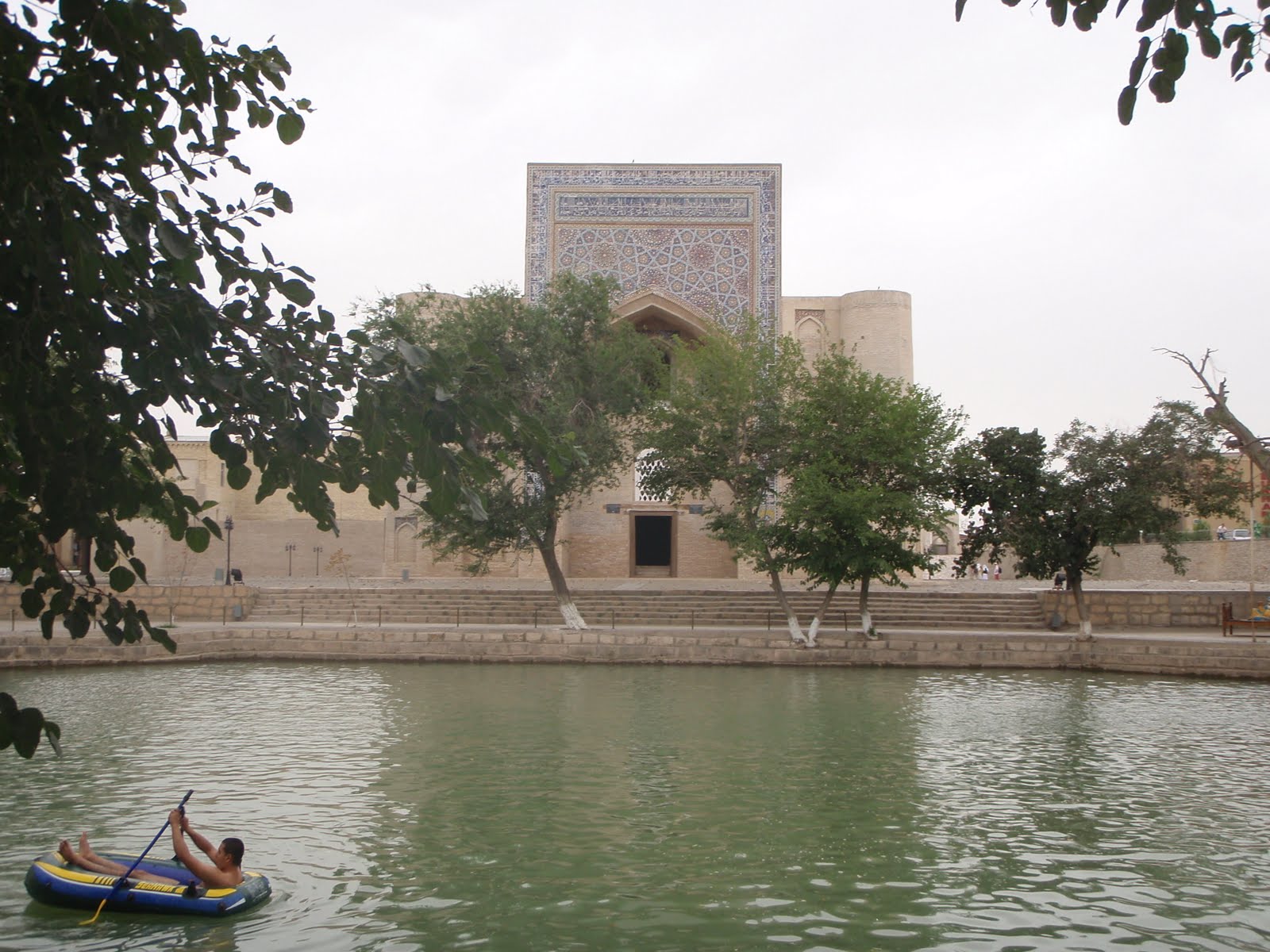
The city of Samarkand is very likable. Similar to Burkhara the glory of their historical significance is all around this place. In Samarkand you can marvel single objects and complete buildings from more than 2500 years history. I found the photos that showed Samarkand about 100 years ago, the most impressive. They showed the decline of this formerly and now again magnificent city. The domes of mosques and medressas had huge holes and the building had taken the yellow-brown color of its surroundings.
On the last evening I went out to have dinner with Remi and Francois. While we ate we heard an unusual selection of music (from Russian pop to the Lion King theme) from an alleged restaurant. On the way back to the B & B we wanted to see what it was all about. Even before we had realized what was happening there, we were asked inside. The restaurant was actually one, but rented for a wedding. The DJ with the unusual choice of music proved to be a live band. We looked at the Uzbek wedding for a while, and then decided that the general alcohol level was too high to stay longer.
After three days I left Samarkand together with Remi and Francois for Tashkent.


Wednesday, June 22, 2011

Uzbekistan I, Burkhara

From the border of Turkmenistan and Uzbekistan, I took a taxi to Burkhara. I was informed of my arrival at the bazaar of Burkhara with the word "Burkhara!" and an appropriate gesture. At that time I had much bigger problems. The question that I asked myself was, if my head would explode or if I would melt as a whole first. I decided to reduce my future vodka consumption and got into a taxi using the simple statement "Hotel" to explain my destination. After a short ride and a small price negotiation, I found myself in a modern hotel room with a soft bed, air conditioning and satellite television. My chances of survival were increased substantially.
In the following days I enjoyed a successful mix of the atmosphere of historic Burkhara combined with an air-conditioned hotel room and satellite television.
Burkhara corresponds roughly to what I had imagined a major city on the Silk Road would look like. With this backdrop, of course, a certain amount of international tourism goes hand in hand. Everything was somewhat easier because I could communicate with people again.
At the end of this post a little side note on Uzbekistan. The largest bill in this country is SUM 1000, equivalent to about 0.45 dollars. The consequence is that one has huge wad of cash in the pockets.


Turkmenistan

Turkmenistan is not interested in tourists. A tourist visa is only available with a tour and a state Travel Guide. That's why I visited this country with a five-day transit visas that allowed me to stay along the main thoroughfares between the border crossings mentioned in my visa. In those five days I was in the cities of Ashgabat, Mary and Turkmenabat.
The capital of Turkmenistan Ashgabat is located a few kilometers from the border with Iran. In this city, the late President Niyasov was born. During his reign he had replaced communism with a sprawling personality cult. He allowed himself to be worshiped as Turkmenbashi.
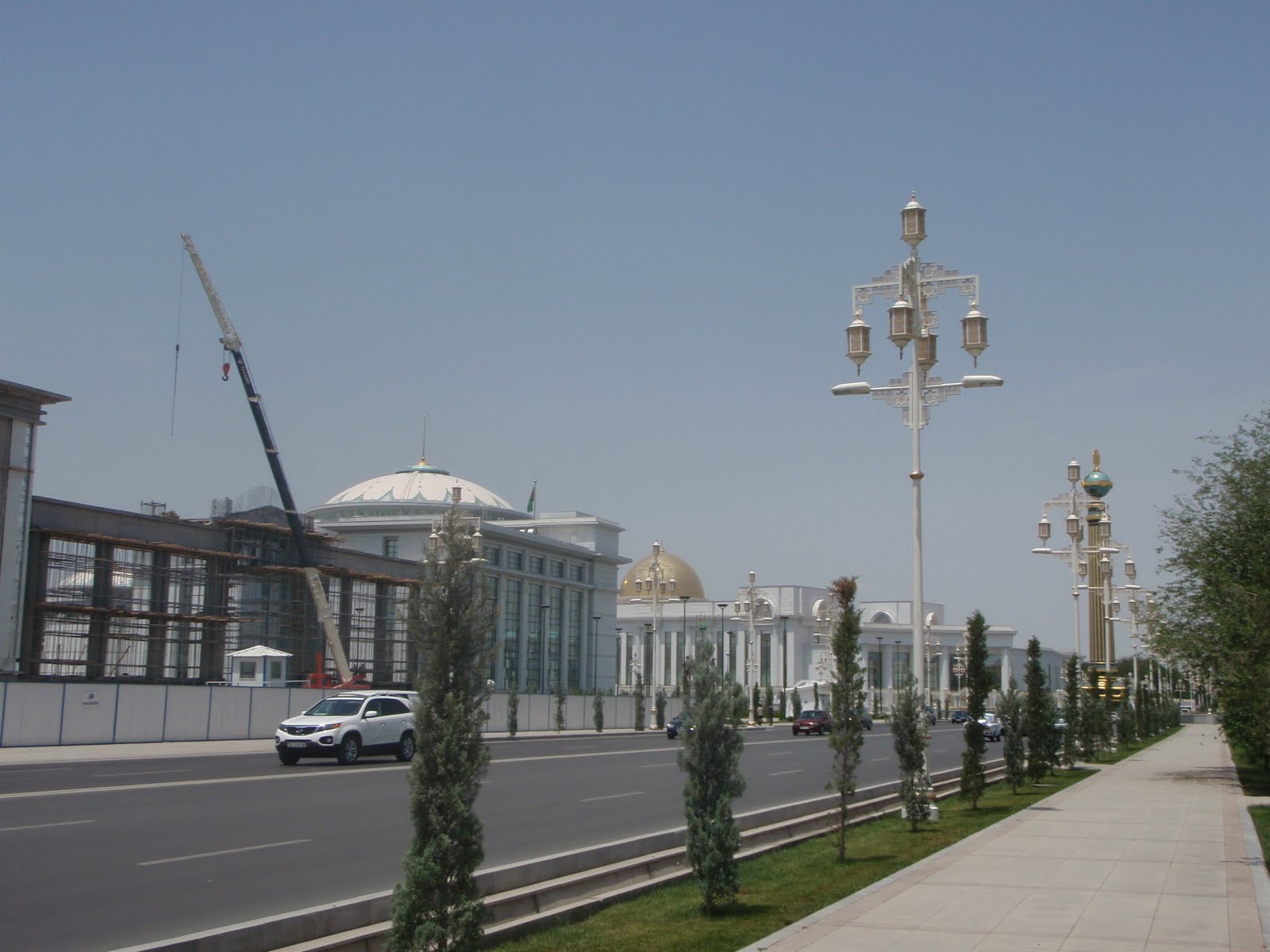
Ashgabat is formed by two goals. First to sent a modern image of Turkmenistan to the world and to praise Niyasov. I could explain in detail why I felt Asgabat is oppressive and boring, and not as intended by the builders modern and impressive. But I'm trying to restrict myself to a few sentences. Most buildings in the center of Ashgabat are not older than 30 years. Instead of a bold, diverse architecture, they are characterized by an incredible uniformity. Everything is white or marble combined with gold. The only distractions are golden statues of Niyasov. The oppressive impression was produced on the one hand by the incredible number of Ministries. I felt every second building is a ministry, some with adventurous purpose (e.g. the Ministry of fairness). Secondly, the uneasy impression through public land and buildings were struck, whose purpose is to impress people but not to serve them. I had tried to find a public toilet while having stomach issues (Hygiene in food preparation or water) in several parks and had to ultimately use one in a government building.
The impression of a misanthropic, especially tourist-hostile environment in Turkmenistan has shown itself to me in two other situations. Firstly, in the hotel rates, there is an over-priced for foreigners and a modest rate for locals. Attempts to renegotiate failed because the prices are specified by a Ministry in Ashgabat. The second situation was my attempt to leave Ashgabat by train. After an elaborate search for the ticket counter, I found it in an outbuilding of the station, but then it was closed for an hour. When it was re-opened they told me that the next available ticket was for the last evening of my visa. So I left Ashgabat with a shared taxi, whose driver had an insane driving style.
In Mary not much happened. Just the same monotony of overpriced hotels, golden statues of Niyasov and schaschliks.
Until my last evening in Turkmenistan, I found little positive in this country. The only thing that gave me joy was the sight of Sand deserts and camels on the roadside during the taxi rides. I had already closed the chapter Turkmenistan internally and just wanted to find a hotel for a maximum of $ 30. But this was extremely difficult. After the fourth hotel demanded a price far beyond my limit, my taxi driver offered to take me to a private place to stay. Once there, the taxi driver demanded $ 30 for the stay. But the owner insisted that I was her guest.
I was extensively supplied with food and tea. As I didn’t speak much Russian, a young woman was brought from the neighborhood. She spoke German very well, due to an au pair job she had done in Germany and Austria.
In the evening, water and electricity supply stopped to work. Electricity, gas and water are free but not necessarily reliably in Turkmenistan. Dinner was served in candlelight and without air condition. But the bigger problem was that I could no longer avoid drinking vodka.
On the morning of the next day I fought myself out of bed and cursed the person who invented vodka. A hangover at 36 degrees Celsius is really cruel. Nevertheless I managed to reach the border.